
Namseoul University
Cheonan ·Private University ·15 programmes ·Official website
Private university in Cheonan offering undergraduate degrees across Engineering, Art & Creative Culture, Global Business and Health Care & Welfare, plus an International Graduate School (IGS) with seven English-track and bilingual master's programmes.
About Namseoul University
Overview
Namseoul University is a private university in Cheonan, Chungcheongnam-do, about an hour south of Seoul. It teaches across four undergraduate colleges — Engineering, Art & Creative Culture, Global Business, and Health Care & Welfare — and runs an International Graduate School (IGS) built specifically for international students, where most programmes are taught in English or on a Korean/English bilingual track.
Why choose Namseoul University?
NSU is one of the more accessible Korean universities for international students. Undergraduate scholarships are tied to TOPIK level (30% at TOPIK 3 rising to 60% at TOPIK 6), and students from developing countries qualify for a 40% tuition scholarship. Strong performers can reach 100% through GPA-based awards. At graduate level, every IGS student receives a 25% academic merit scholarship, and most programmes require no Korean at all — an IELTS 5.5 or TOEFL iBT 71 is enough.
Campus & facilities
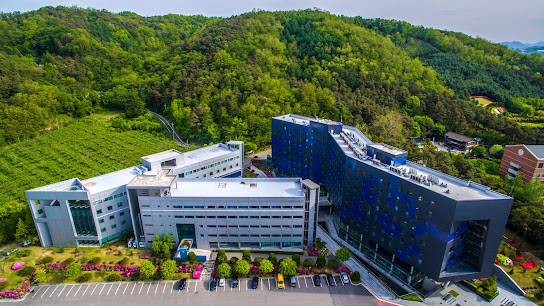
The campus is in Seonghwan-eup, Cheonan — well connected to Seoul by rail. On-campus housing is provided by the two Elim dormitory buildings, offering two- and four-person rooms. Dormitory fees are charged per semester with a separate ~US$15 deposit, and students who maintain a GPA of 3.0 with certified TOPIK level 3 or above can have the full dormitory fee covered.
Admission requirements
Undergraduate applicants apply through NSU's online application form and must submit an identification photo, passport, proof of graduation, financial evidence and a handwritten identity declaration. Language requirements are TOPIK 3+ or IELTS 5.5 / TOEFL iBT 59 / NEW TEPS 202 / CEFR 5.5. IGS master's applicants submit a document pack including an apostilled bachelor's diploma and transcript, a study plan, consent forms, and a bank certificate showing at least USD 13,000 (about US$11,400 at the e-visa stage, freshly issued). English-track applicants need IELTS 5.5, TOEFL iBT 71, NEW TEPS 327 or CEFR B2 — waived for nationals of English-speaking countries or graduates of English-medium degrees.
Scholarships & financial aid
Undergraduate: TOPIK 6 — 60%, TOPIK 5 — 50%, TOPIK 4 — 40%, TOPIK 3 — 30%. Students from countries with GNI per capita of USD 10,000 or less qualify for a 40% tuition scholarship. Continuing students are funded on GPA and year ranking — up to 100% for first in year with GPA 4.00+, 70% second, 50% third, 35% for GPA 4.00+, 30% for GPA 3.5–3.99 and 25% for GPA 3.0–3.49. Separate one-off TOPIK awards pay about US$360 (level 3) up to about US$1,430 (level 6). Full dormitory fee support is available at GPA 3.0 with TOPIK 3 or higher. IGS: a 25% academic merit scholarship applies every semester, requiring GPA 3.0 to maintain, alongside the Seong-Am (about US$1,790), Achievement and Research Assistant scholarships.
Key highlights
- International Graduate School — 7 master's programmes, mostly English-track
- Undergraduate scholarships of 30–60% based on TOPIK level
- 40% tuition scholarship for students from developing countries
- Merit scholarships up to 100% for high-performing students
- Full dormitory fee support at GPA 3.0 with TOPIK 3
- On-campus Elim dormitories from about US$400 per semester
Programmes & tuition (15)
Engineering degrees across the college. Tuition shown is the freshman first-semester rate.
Design-focused majors within the College of Art and Creative Culture.
Applied Music Theory within the College of Art and Creative Culture.
Sport Business Management, and Sport & Health Care under Health Care and Welfare.
Social Sciences majors within the College of Global Business.
Liberal Arts and Health Administration — the most affordable undergraduate track.
Beauty & Health Care within the College of Health Care and Welfare.
Clinical and health-science majors. Highest undergraduate tuition band.
Master of International Business — taught entirely in English. Part of the International Graduate School (IGS). Every IGS student receives a 25% academic merit scholarship; a GPA of 3.0 or above is required to keep it.
Master of International Education — taught entirely in English. Part of the International Graduate School (IGS). Every IGS student receives a 25% academic merit scholarship; a GPA of 3.0 or above is required to keep it.
Master of Global Addiction Rehabilitation Counseling — bilingual delivery. Part of the International Graduate School (IGS). Every IGS student receives a 25% academic merit scholarship; a GPA of 3.0 or above is required to keep it.
Master of Global Hospitality Management — taught entirely in English. Part of the International Graduate School (IGS). Every IGS student receives a 25% academic merit scholarship; a GPA of 3.0 or above is required to keep it.
Master of Global Techno-Entrepreneurship — taught entirely in English. Part of the International Graduate School (IGS). Every IGS student receives a 25% academic merit scholarship; a GPA of 3.0 or above is required to keep it.
Master of Global Physiotherapy — bilingual delivery. Part of the International Graduate School (IGS). Every IGS student receives a 25% academic merit scholarship; a GPA of 3.0 or above is required to keep it.
Master of Rehabilitation Exercise — bilingual delivery. Part of the International Graduate School (IGS). Every IGS student receives a 25% academic merit scholarship; a GPA of 3.0 or above is required to keep it.
One-time fees
Upcoming intakes
| Intake | Applications open | Close | Documents due |
|---|---|---|---|
| fall · R1 | — | — | 2026-07-02 |
| fall · R1 | — | — | — |
| fall · R2 | 2026-07-13 | 2026-07-17 | — |
Studying in South Korea — what to know
Monthly living expenses typically range ₩500,000–₩1,000,000 for food, transport and essentials. Dormitories are around ₩200,000–₩400,000/month, and provincial cities cost less than Seoul.
Many programmes are taught in English; most universities offer Korean courses. Basic Korean (TOPIK 1–2) is needed for some programmes. We provide language training and TOPIK prep.
International students study on a D-2 visa. We guide you through the entire visa process. It allows part-time work up to 20 hours/week in term and full-time during vacations.
Korea has world-class healthcare. Students join the National Health Insurance (NHIS) — roughly ₩60,000–₩80,000/month — covering most medical costs.